
Door and window hardware mainly includes the following types of core components, covering functional requirements such as opening, closing, load-bearing, sealing, and safety:
I. Basic Connection and Load-Bearing Components
1. Hinges
Used to connect the door or window sash to the frame, enabling the outward-opening function. Common types include ordinary flat hinges, C-shaped groove hinges (suitable for European standard profiles), heavy-duty hinges (for large doors and windows), and friction stay hinges specifically for outward-opening windows. Modern high-end system windows use stainless – steel hinges that can bear a load of up to 200 kg and support extra – large sashes up to 3 meters in height.

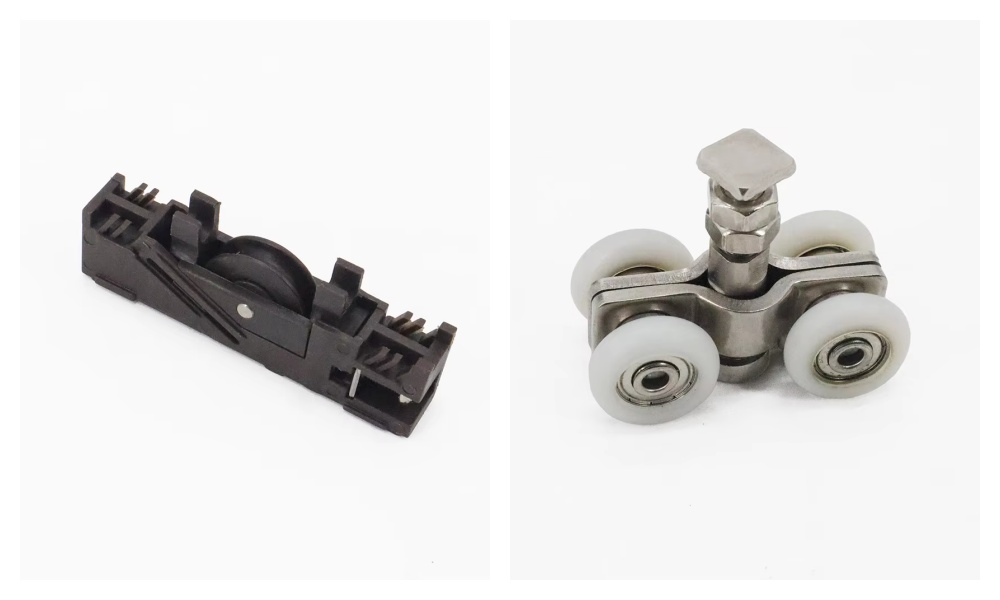
2. Pulley Roller and Tracks
Core components of sliding doors and windows. The pulley roller system is installed at the bottom of the window sash, and the track is directly formed on the window frame profile. High – quality slide rails can reduce friction and prevent the window sash from deviating. Some sliding windows adopt a hidden – track design, taking into account both aesthetics and durability.
II. Operation and Locking Systems
1. Handles and Grips
Components for manually operating the opening and closing of doors and windows. Handles are usually integrated with locks. Common types include swivel handles and multi – point lock handles. Grips are more often used for sliding windows. In some high – end windows, the handle function is directly formed through the profile shape. New – type hardware systems adopt a modular design, with the handle integrating 4 opening modes (such as inward – opening locking, inward – tilting locking), suitable for scenarios such as child safety.

2. Locks and Transmission Mechanisms
Lock Point System: Casement windows mostly use multi – point locking devices. Multiple lock points are linked through a transmission rod to improve wind pressure resistance. Inward – tilting and inward – opening windows are equipped with link – type multi – point locks, which can achieve both 平开 and inward – tilting functions simultaneously.

Lock Types: Include bolt locks, crescent locks, smart fingerprint locks, etc. Bolt – type locks are commonly used for sliding windows, while high – end system windows are equipped with transmission locking devices with stronger anti – theft performance. Some locks support remote control and air pressure self – adapting functions, suitable for high – rise buildings.
III. Positioning and Limiting Devices
1. Wind Braces and Limiters
Limit the opening angle of doors and windows to prevent wind – blown collisions. Telescopic wind braces are commonly used for top – hung windows, and folding wind braces are more often used for casement windows. Some wind braces are integrated with buffer buckles to counteract the self – suction phenomenon of window sashes caused by the air pressure difference in high – rise buildings.

2. Door Stops and Window Stops
Fix the opened doors and windows to avoid accidental closing. Door stops are commonly of two types: floor – mounted and wall – mounted. Window stops are mostly used in scenarios where ventilation needs to be maintained.
IV. Sealing and Protective Components
1. Sealing Strips
Made of rubber or silicone materials, installed around doors and windows to achieve functions such as windproofing, waterproofing, and sound insulation. Some sealing strips achieve micro – slit ventilation through a virtual – overlap design, and can replace 30 – 120 cubic meters of air per hour while maintaining heat insulation.

2. Anti – collision Strips and Rubber Pads
Reduce the impact force when doors and windows are closed, protecting the profiles and glass. They are commonly found at the edges of casement sashes and at the bottom of sliding window tracks.
V. Special – function Hardware
Angle Brackets and Connectors
Reinforce the corners and joints of the door and window frames, enhancing overall stability. Modern system windows mostly use die – cast angle brackets, combined with corner – joining glue to improve anti – deformation ability.

VI. Material and Safety Considerations
The materials of hardware components directly affect their performance:
Stainless Steel: Has strong corrosion resistance and is often used in key components such as hinges and lock bodies.
Zinc Alloy: Is easy to process and has a low cost, but attention should be paid to the surface nickel – plating process to improve the anti – corrosion level (up to level 5 at most).
Copper: Has outstanding antibacterial properties and is suitable for areas such as kitchens and bathrooms where bacteria are likely to grow.
Aluminum: Is lightweight and has high strength, and is often used in components such as handles and tracks.
In addition, auxiliary devices such as child safety locks and anti – theft chains can further enhance the safety of doors and windows. Different window types (such as inward – tilting and inward – opening windows, sliding – folding windows) need to be matched with exclusive hardware systems. For example, inward – tilting and inward – opening windows need to be equipped with special components such as top – mounted scissor – type connectors and lower – corner hinges.